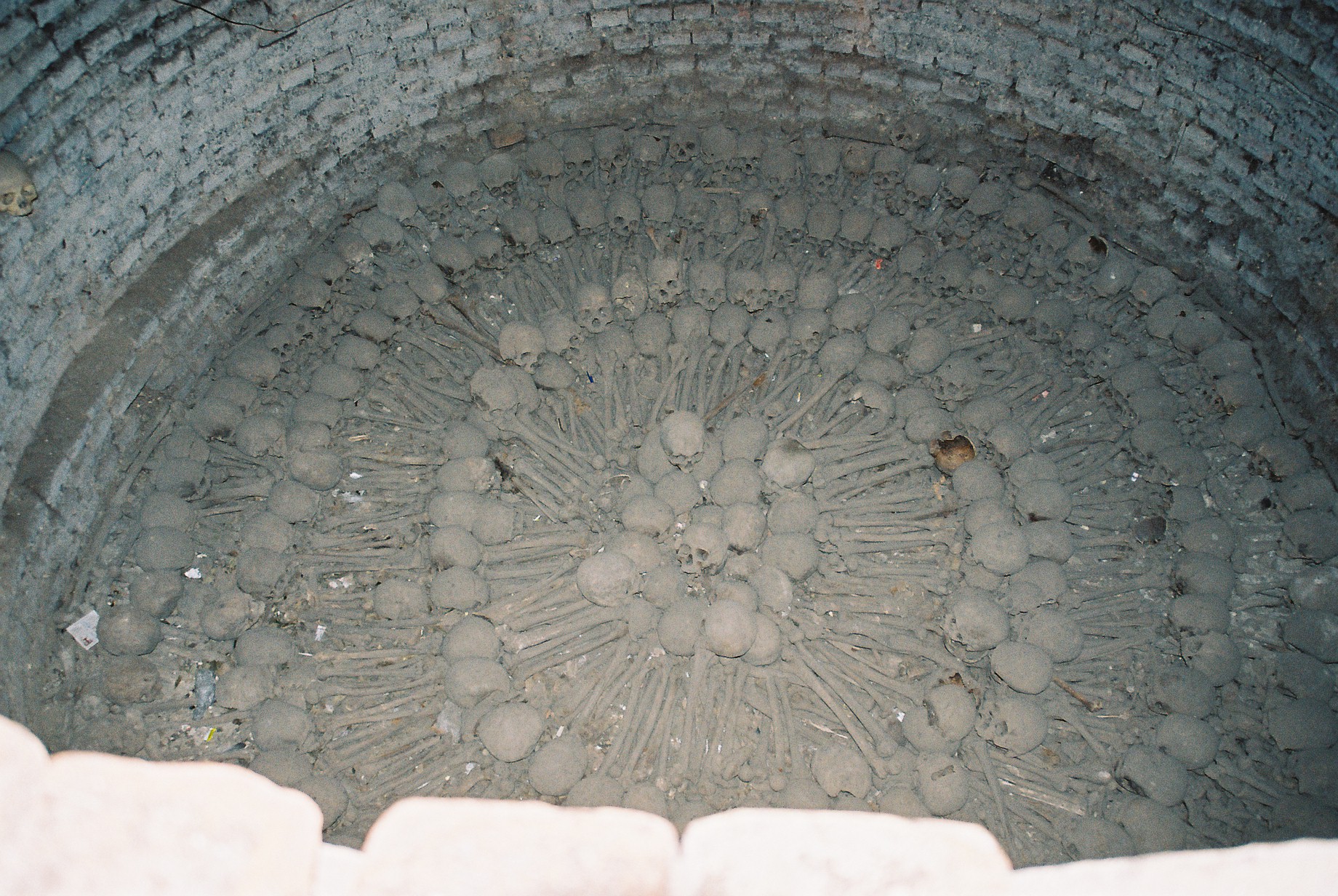
Lima was the capital of the Viceroyalty of Peru from 1542 until South American independence in the 1820s, the administrative centre of Spain’s Pacific South American empire, and for most of that period the most significant city on the continent. The wealth that passed through it was considerable: silver from Potosí in present-day Bolivia moved through Lima on its way to the Spanish treasury, and the city built itself accordingly, in the ornate baroque style that the Catholic Church favoured for its colonial missions and that can still be read in the historic centre’s churches and the Plaza Mayor. The Basílica y Convento de San Francisco, the church at the centre of the historic district, was built in the seventeenth century and contains, beneath its floor and under its gardens, a catacomb complex that held the remains of approximately 25,000 people, organised by bone type in niches and arranged in concentric patterns that the Catholic tradition of burial in consecrated ground produced here on a scale the scale of early Lima’s mortality required.
The catacombs are open to visitors with guided tours and are one of the few places in Lima’s historic centre where the weight of what the colonial period actually cost the people living through it becomes physically legible. The arrangements of skulls and femurs in the niches are presented as historical and architectural interest, which they are, but they are also the remains of people who died in a city that grew because of the colonial extraction economy, many of them indigenous Peruvians and enslaved Africans for whom Lima was neither a destination of choice nor a place of particular prosperity. The guide I had was informative and enthusiastic and slightly careful about which parts of the history he dwelt on.
I met a reader of the blog in Lima, someone who had been following the trip from an early point and who recognised me in the street near the Larcomar shopping centre in Miraflores. This is an experience I was not prepared for and which produced a level of social awkwardness that I hope I managed adequately. They were kind and gracious about it and we had a brief conversation about the trip before going our separate ways. The moment sticks because it is a reminder that writing publicly is a transaction, that the words are read by specific people in specific circumstances, and that occasionally those circumstances include standing on a pavement in Lima.
Peru’s food deserves the international reputation it has built over the past decade. Lima in particular has become one of the world’s significant restaurant cities, with several establishments occupying positions on the annual lists of the world’s best restaurants, a recognition that reflects the genuine depth and diversity of Peruvian culinary tradition: the Andean ingredients of potato, quinoa, and oca combined with Japanese techniques brought by the Japanese immigration of the twentieth century in the nikkei tradition, Amazonian ingredients finding their way into coastal preparations, the acidic citrus marinade of ceviche meeting Chinese influences in the chifa tradition. All of this is available in Lima at levels from street food to internationally cited fine dining, and the street food is, characteristically, the most immediate and the most honest expression of what the cuisine actually is.
All of this is available in Lima at levels from street food to internationally cited fine dining, and the street food is, characteristically, the most...

Share