A Trip of a Lifetime: The Route

A Trip of a Lifetime: The Route

5 min read

Share

Copied!
Tweet WhatsApp

“Machu Picchu was built by people who had no wheel and no iron and somehow produced architecture that has survived seven hundred years in earthquake country.”

Russell laid the itinerary on the counter and we both looked at it for a moment. Six hours in STA Travel on Barnsley high street had produced a piece of A4 paper that appeared, on first reading, to contain a misprint. The countries ran down the page in two columns: Japan, China, Nepal, Tibet, India, Vietnam, Cambodia, Laos, Thailand, Malaysia, Indonesia, Bali, Australia, New Zealand, Chile, Argentina, Paraguay, Peru, Ecuador, Brazil. Twenty countries. Approximately fifty thousand miles. Roughly two years. Russell had the patience of a man who understood that some customers need to be talked down from their own ambitions and others need to be talked up into them. He had spent the afternoon doing the latter, and the Starbucks I had fetched him at lunchtime was probably inadequate compensation.

The route follows a logic that reveals itself once you spend enough time with a globe. It begins in Japan in early March, when the cherry blossom is still a few weeks away and the tourists who come specifically to photograph it have not yet arrived, and then moves south and west through Asia in the general direction of warmth, spending time in the countries that carry serious historical weight alongside the ones that are simply beautiful, and trying not to mistake the two categories for each other. From Japan down through the Philippines and into China, then overland through Tibet to Nepal, south into India and back across into Southeast Asia, down through Malaysia and Indonesia to Bali, and then east to Australia and New Zealand before the long crossing to South America and the continent I know least about and am most curious about, which is probably the right reason to go somewhere.

Japan sits at one end of the arc for reasons that are partly practical and partly about the kind of country it is. It is, in ways that are difficult to summarise without oversimplifying, the most coherently itself country in the world, a place that has spent a thousand years developing a relationship with its own culture that is simultaneously open to external influence and profoundly resistant to being reshaped by it. The Japanese borrowed writing systems from China, Buddhism from India via Korea, constitutional democracy from the Americans who drafted their post-war constitution for them in 1947, and integrated all of it into something that is recognisably Japanese in the way that almost nothing else is recognisably Japanese. Starting there, with a country that presents itself so clearly and demands that you pay attention on its own terms, seems like the right calibration for everything that follows.

Six hours in STA Travel on Barnsley high street had produced a piece of A4 paper that appeared, on first reading, to contain a misprint.

A Trip of a Lifetime: The Route

China requires a different kind of attention. The country contains a fifth of the world’s population, has the second-largest economy on earth, and is in the process of constructing cities at a pace and scale that has no historical precedent anywhere. It is also a country whose government maintains a degree of control over information and public life that makes its own story genuinely difficult to read from the outside, a situation that produces in Western observers a range of responses from admiration to alarm, most of which say as much about the observer as about the country being observed. Spending time there, rather than reading about it, seems like the obvious corrective.

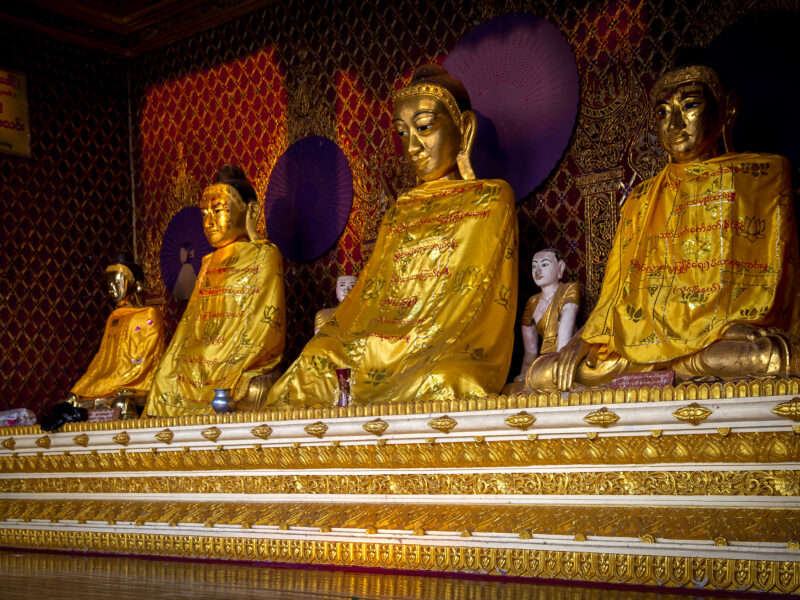
Tibet is on the route because the route goes through it, but also because it is one of those places whose situation demands engagement. The Chinese government has administered Tibet since 1950, when the People’s Liberation Army crossed the border and the seventeenth-point agreement formalising the relationship was signed. The Dalai Lama has been in exile in India since 1959. The railway connecting Lhasa to the rest of China was completed in 2006, running at altitudes that required engineering solutions that had never previously been attempted. Whether these developments represent development or occupation or something that can’t be adequately described by either word is a question I would rather form a view on after being there than before.

Southeast Asia, the long middle section of the route, is the part I know best from reading and least from experience. Vietnam carries the weight of a war that the Americans called the Vietnam War and the Vietnamese call the American War, which is the same conflict described from a different direction. Cambodia has a more recent history of atrocity that is less widely known in Britain than it deserves to be. Laos was bombed so heavily by the United States during the Indochina period that it remains the most heavily bombed country per capita in history, a distinction that receives very little attention relative to the bombing itself. These are places where the recent past is present in a way that Europe mostly no longer is, and visiting them without understanding what happened there would be a particular kind of wilful ignorance.

Tibet is on the route because the route goes through it, but
also because it is one of those places whose situation demands engagement.

South America is the unknown quantity. The continent has its own colonial history, its own specific forms of inequality and political instability, its own relationship between the land and the people who have always lived on it and the people who arrived with different intentions. The Andes run its length like a spine. The Amazon contains water that the world cannot afford to lose. Machu Picchu was built by people who had no wheel and no iron and somehow produced architecture that has survived seven hundred years in earthquake country. I know these things as facts and would like to know them as places.

The visa applications for China and Nepal are already filed. The flights are booked. The bank balance, having absorbed the cost of all of this, looks like something that needs time and distance before it can be examined honestly. The adventure starts on the first of March 2011.

Russell said have a good trip. He says it to everyone. Standing on Barnsley high street with fifty thousand miles of itinerary in my hand, it was the most significant sentence I had heard all year.

The country contains a fifth of the world's population, has the second-largest economy on earth, and is in the process of constructing cities at a...